
Can We Predict the Salary of a Developer?
Overview
This project explores whether we can reasonably predict a developer’s annual compensation using self-reported survey data from the 2025 Stack Overflow Developer Survey.
Project motivations:
- I would like to understand how coding experience, programming language, years of coding experience, education level, and job positions affect the salary of developers.
- I also wonder if it is possible to predict the salary using these factors.
Section 1: Business Understanding
The project aim to answer below questions.
- How does the coding experience influence salary of developer?
- How does the role affect the salary of developers?
- Does developer salary vary with country?
- Would education level change the salary of developers?
- Which language has highest salary?
- Can we train a Random Forest Model to predict salary using selected features?
Section 2: Data Understanding
Dataset
- Source: 2025 Stack Overflow Developer Survey (ODbL license)
- Respondents: 49,000+ responses from 177 countries
- Data type: Self-reported survey responses
Features used
- Years of professional coding experience
- Country
- Primary developer role
- Primary programming language
- Education level
- Annual compensation (USD, normalized by Stack Overflow)
Data cleaning
- Removed missing or extreme salary values
- Converted years of experience to numeric
- Simplified multi-select fields (primary role, primary language) by selecting the first response
- Dropped incomplete records after feature selection
These choices intentionally trade completeness for simplicity and explainability.
Section 4: Data Modeling
We trained a Random Forest Regressor using:
- One-hot encoding for categorical features
- 80/20 train-test split
- No hyperparameter tuning (baseline model)
Section 5: Evaluation
Feature Analysis
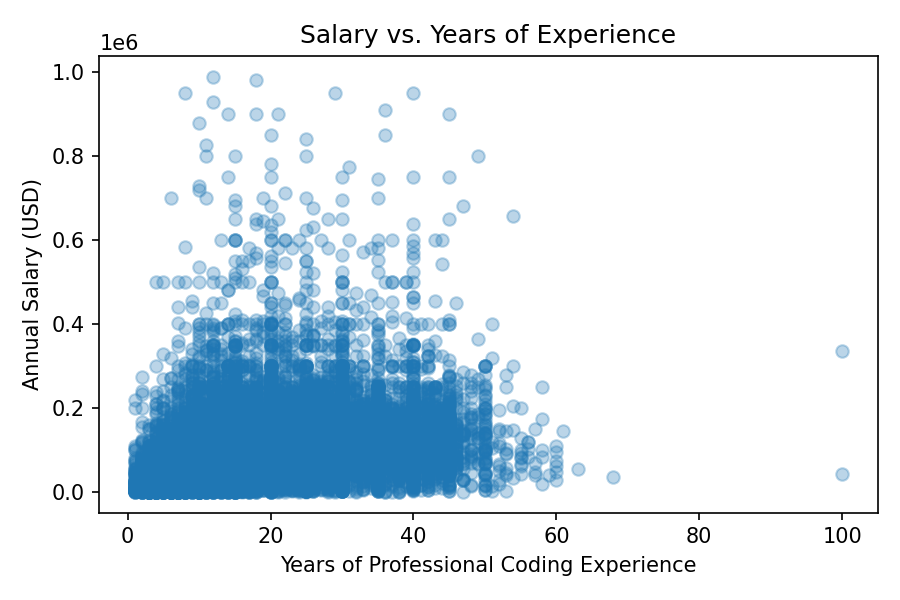
How does the coding experience influence salary of developer?
Observations
- To answer this question, a scatter plot is created to observe the correlation between salary and years of coding experience.
- Salary increases with years of coding experience.
- However, data is in wide range of variance, suggesting other factors also matter.
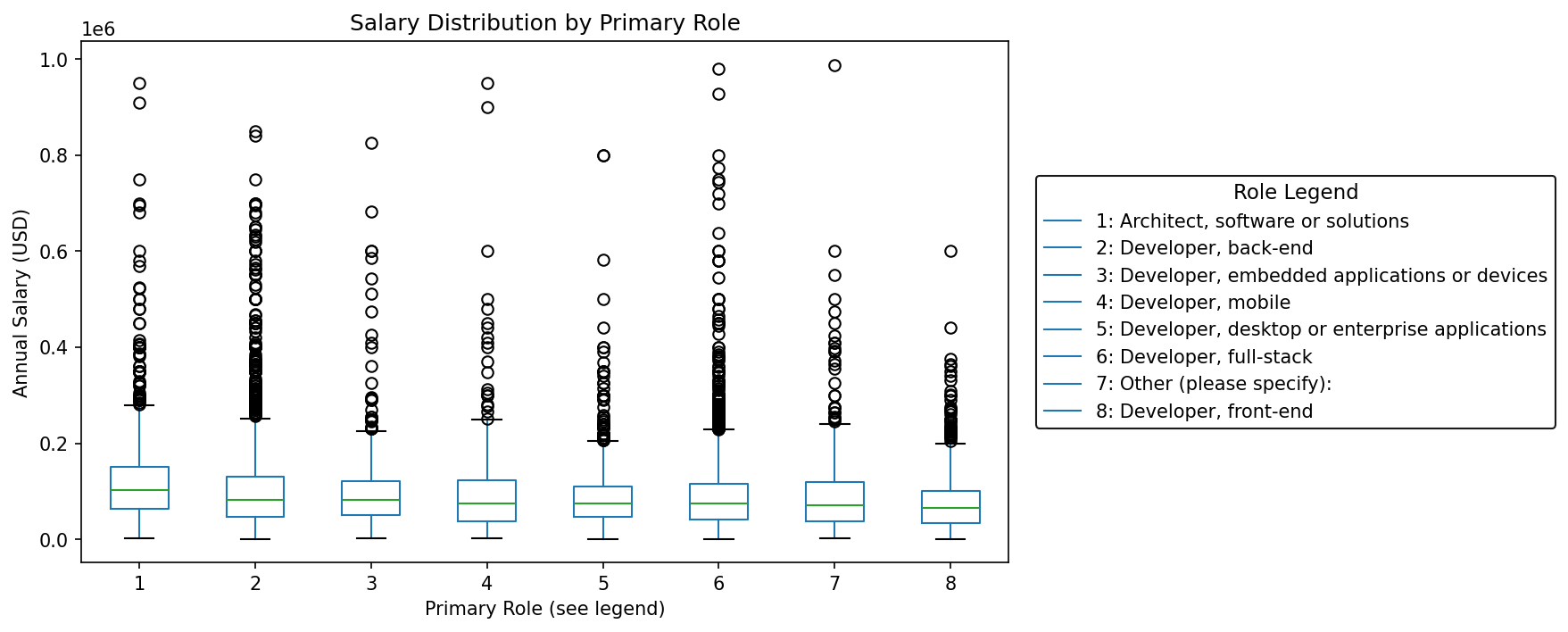
How does the role affect the salary of developers?
Observations
- To answer this question, a boxplot graph is created to observe the salary distributions for each role.
- Architect, software or solutions, has highest median salary than other roles.
- Each role has many outliers on top salary range. This could be due to other reasons, such as country, experience, etc.
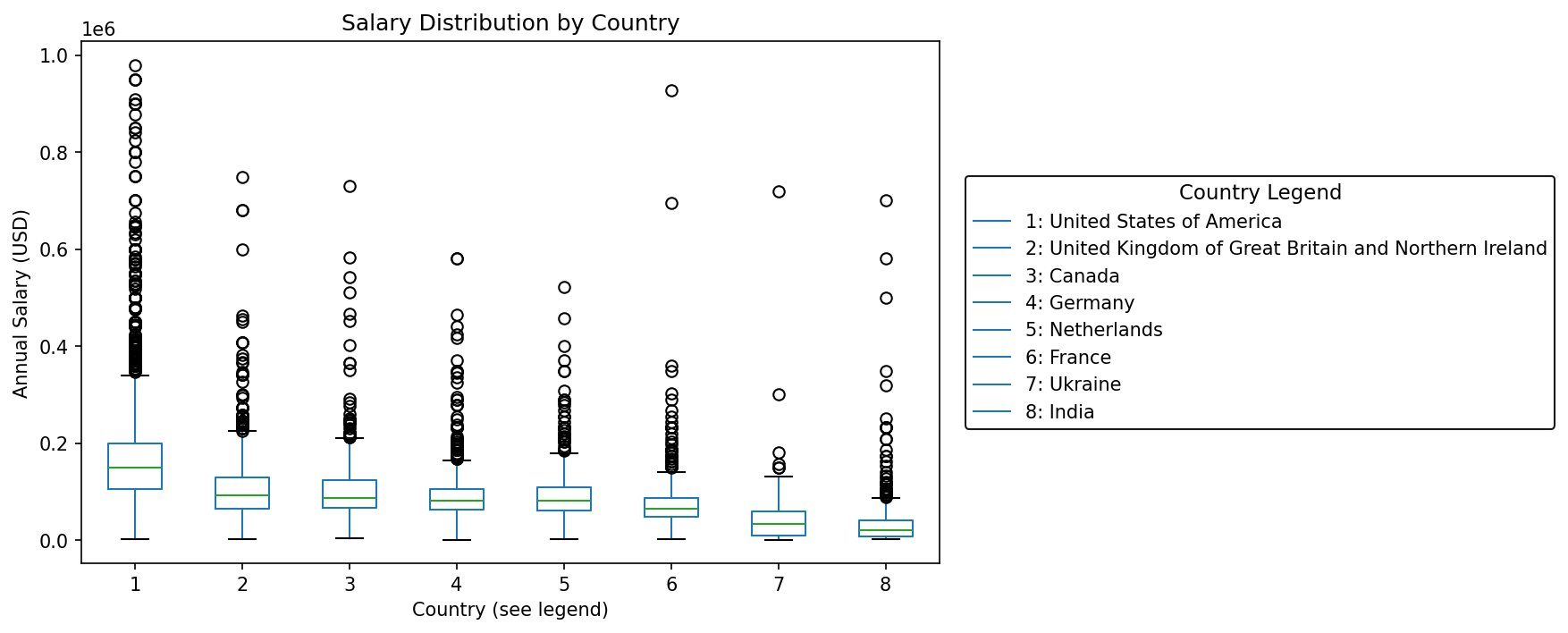
Does developer salary vary with country?
Observations
- To answer this question, a boxplot graph is created to compare salaries from different countries.
- Developers from United States have highest median salaries compared to other countries.
- Each country has many outliers on top salary range due to other reasons, such as experience, role, etc.
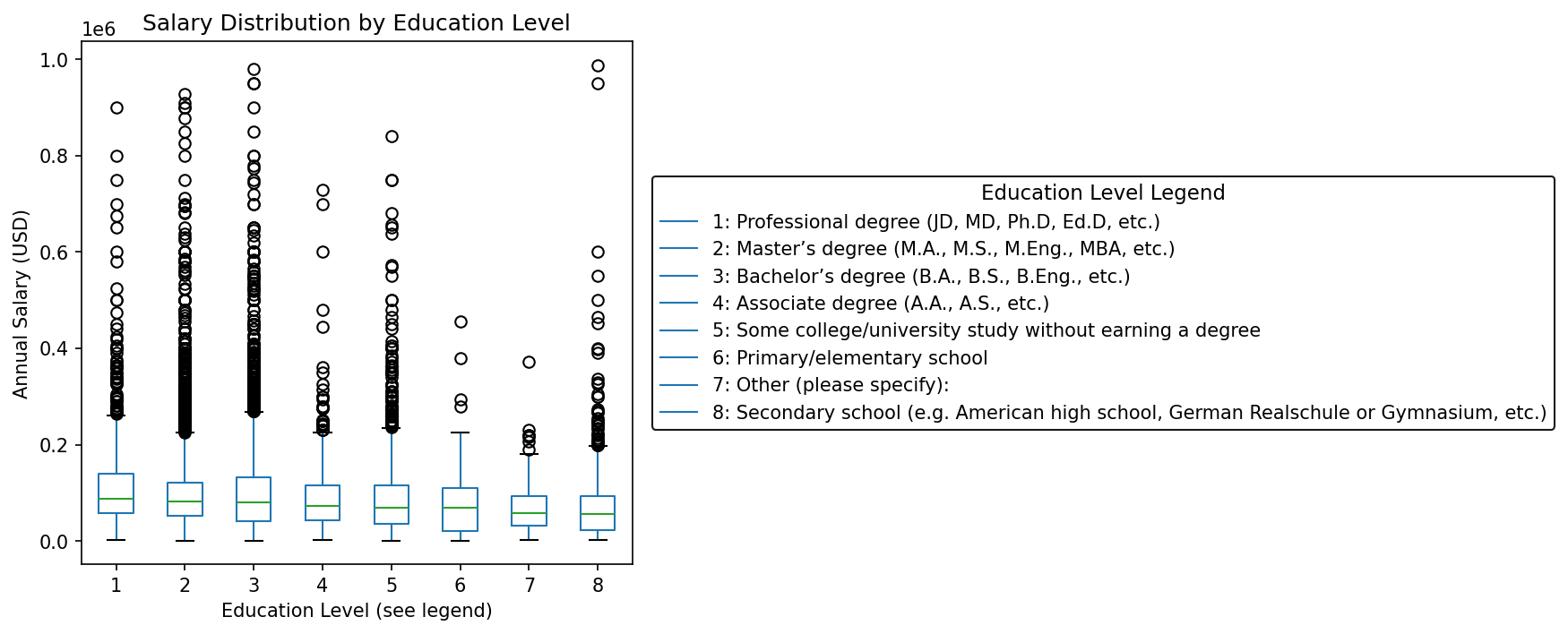
Would education level change the salary of developers?
Observations
- To answer this question, a boxplot graph is created to compare salaries of develops with different educations.
- The median salary ranking follows the order of Professional > Master’s > Bachelor’s > Associate > Others.
- However, the difference between education levels is quite small.
- The education levels above college or secondary school level have many outliers in high salary range. The graduate degree didn’t show obvious benefits than college degree.
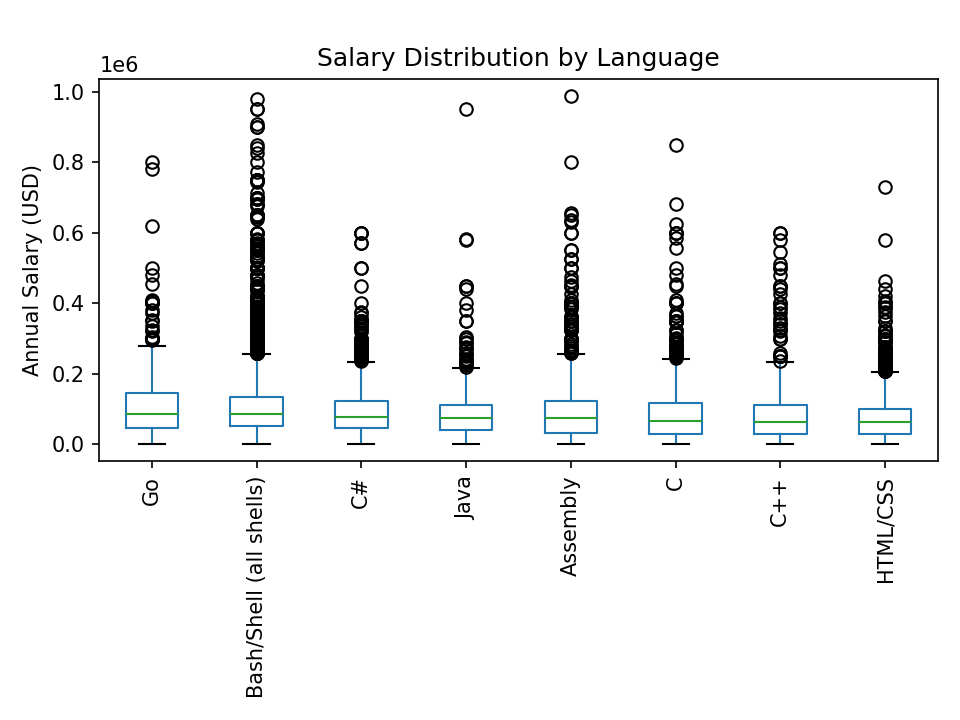
Which language has highest salary?
Observations
- To answer this question, a boxplot graph is created to compare salaries across different programming languages.
- The median salary ranking follows the order of Go > Bash/Shell > C# > Java > Others
- The difference between languages is very small.
- All languages have outliers in high salary ranges. The Bash/Shell and Assembly have highest outliers than others, possibly due to a demand in specific expertise.
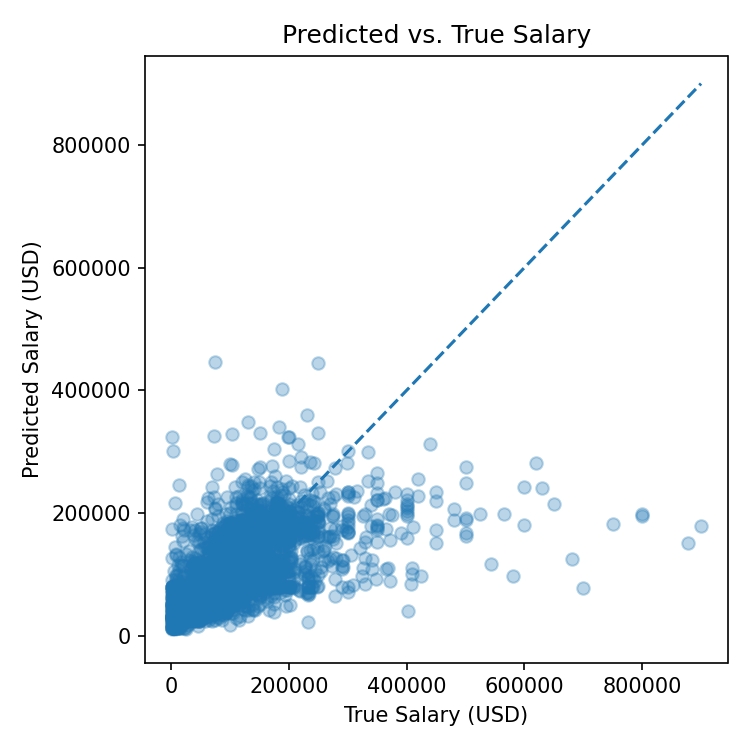
Can we train a Random Forest Model to predict salary using selected features?
Observations
- The predicted value is aligned with true values in low salary range (<400,000).
- The model underpredicted the high salary range (>=400,000). There could be other factors contribute to the high salary.
Feature Importance
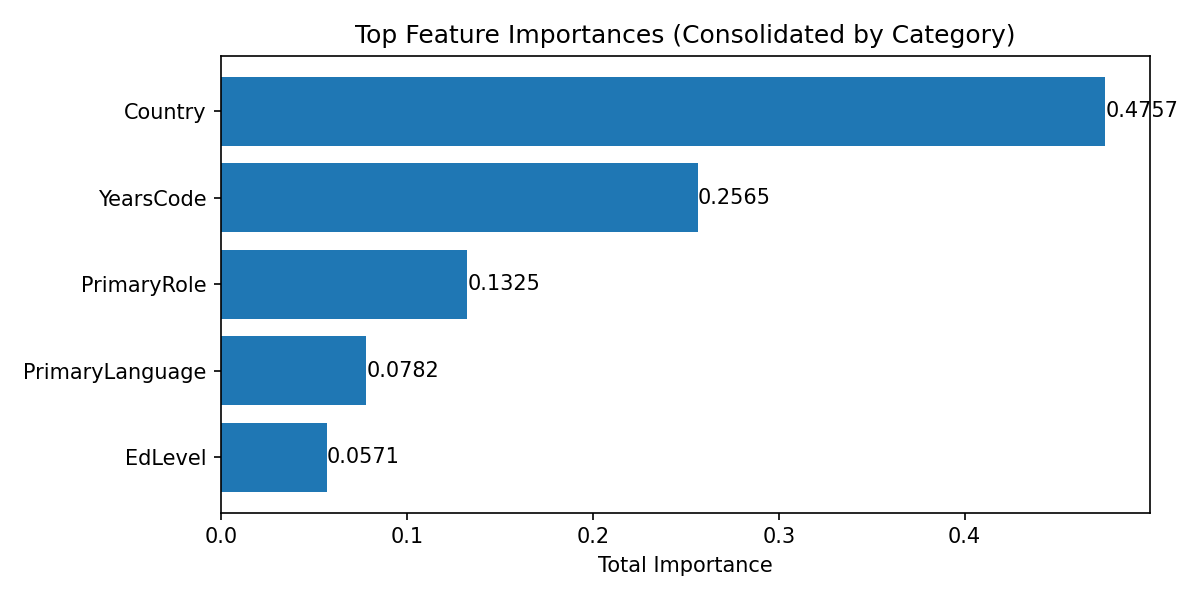
- Country is the strongest factor. It explains about 48% of the model’s predictive power.
- Years of coding experience is the second strongest factor, explaining about 26% of the model’s predictive power.
- Professional role explains about 13% of the model’s predictive power.
- The programming language and education level have small influence, with each one explaining less than 10% of the model’s predictive power.
Model performance
- Mean Absolute Error (MAE): ~$38,511
- R² Score: ~0.39
Interpretation:
- Predictions are often within ~$39k of reported salary.
- Roughly 40% of salary variance is explained by the model.
- The 60% of unexplained variance could be due to missing factors, such as network, negotiation skills.
Conclusions
- The major factors to influence developer salary are country and coding experience, together explaining about 75% of model’s predictive power.
- The RF model can explain roughly 40% of salary variance. It underestimated the salary for high value range (>400,000), possibly due to missing other factors.
Limitations
- The data is self-reported and may not be accurate
- Model prediction power is limited (R²=0.44)
- Many factors are ignored to simplify the model for demo purpose